
Thirty-four years after he traveled to space, Wing Commander Rakesh Sharma tells Rediff.com's Archana Masih that he looks forward to Gaganyan, India's first manned space mission in 2022.
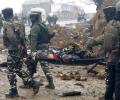
'Definitely, they are going to attempt this, not only in Kashmir but elsewhere, maybe in the Jammu area and beyond.' 'They would want to expand the battle space and the conflict area.'

With Beijing having had a profound rethink on India's admission as a full member of the Shanghai Cooperation Organisation, the tectonic plates of the geopolitics of a massive swathe of the planet stretching from the Asia-Pacific to West Asia are dramatically shifting. That grating noise in the Central Asian steppes will be heard far and wide -- as far as North America, says Ambassador M K Bhadrakumar.

Prime Minister Narendra Modi's three-day visit to Britain has seen India and the UK agreeing on Rs 90,000 crore deals.

The plan of UID/Aadhaar-based surveillance does not end with the collection of fingerprints and iris scan, it goes quite beyond it and poses a lethal threat to the idea of India, says Gopal Krishna.

'If you destroy the assets in Pathankot, you degrade the combat potential of India; you degrade the war potential of India.'
.jpg)
The eternal question remains unanswered, what price security and what cost liberty, says Vikram Sood.

It was Obama's eighth and final address to the UN General Assembly as the US President

The virus had broken out in the lead-up to the opening ceremony in Pyeongchang last Friday and led to some 1,200 security staff being quarantined. Organisers had to call in military personnel to replace them.
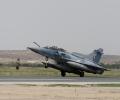
No one really knows what proportion of the nation's wealth and income are available for defence

The visit of Park Geun-Hye to India, though a symbolic one, will certainly give a further impetus to the strategic partnership between the two countries says Rup Narayan Das.

50 years after the 1965 War, India still thinks we can have a 'limited war' when our opponent has time and again shown it does not believe in a limited war, says Colonel Anil A Athale (retd).

Moving ahead with their new mantra -- Chalein Saath Saath: Forward Together We Go -- Prime Minister Narendra Modi and United States President Barack Obama on Tuesday vowed to deepen cooperation in every sector for the benefit of global stability and people's livelihoods over the next ten years.

Since the 1984 national elections, no party has won a clear majority in the lower house of Parliament, a US intelligence report has observed. Vicky Nanjappa reports.
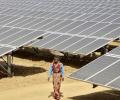
Arunabha Ghosh on why India will increasingly become an energy great power, but not an energy hegemon.
Tragic as it is, the submarine accident is more tactical in nature and it is the deeper strategic malaise across the board -- political, economic, security, judiciary, bureaucracy and even the media -- that has led to this dark mood of gloom and despondency, says Commodore (retd) C Uday Bhaskar.

'She was the only prime minister who won a decisive military victory.' 'She won a real war; she didn't play video games on prime time TV over surgical strikes!' 'She understood power better than any other politician, saw it as her birthright and used it with inborn expertise.' 'Every politician today who tries to be a "supremo" through populism and absolute control over his or her party is referring to the Indira Gandhi playbook!'

'Over the last two decades, the India-French relationship has grown steadily, no major political difference having darkened the sky between Paris and Delhi,' says Claude Arpi.

The administration and America Inc have invested in Narendra Modi's power to transform India. Aziz Haniffa/Rediff.com reports from Washington, DC.

The country has a fiendishly complicated electoral system that is a combination of population-based proportional representation and party-based national lists, says Aditi Phadnis

'Unlike Dr Manmohan Singh, who quailed and turned away because the darkness was too frightening, Modi has taken a leap to the other side. He deserves applause for this fearlessness,' says Aditi Phadnis.

Prime Minister Narendra Modi on Tuesday said Australia will not be at the periphery of India's vision but at the centre of its thought, as he called for closer bilateral security cooperation and a comprehensive global strategy to tackle the menace of terrorism.

'The thin line is a permanent dilemma with soldiers. You have to appreciate that in that dilemma and chaos there are officers who stand and lead their men.

'If one observes a common man passing a church or gurdwara or dargah, he instinctively bows his head. It is this prevalence of polytheism that has ensured that monotheists and minorities flourish in India. This may sound preposterous in wake of the recent communal clashes in Muzaffarnagar. But it must be understood that in a county of over one billion people that was at worst an aberration,' says Colonel Anil A Athale (retd).
NSA Menon's wisdom says that the idea to be superpower is not really desirable, it is better to be different. Sheela Bhatt reports.

'India is no longer the India of the '70s and the '80s.' 'It's a large country with the fastest growing economy.' 'In working with India, you just can't go and humiliate the nation publicly.' USIBC President Mukesh Aghi tells Aziz Haniffa/Rediff.com about how he advises American companies to do business with India, what he thinks of Modi's government and the way forward for the India-US relationship.

'Our approach to India is no different from the approach that we have made in India over the years, recognising its non-aligned status. That's their decision; we're not trying to change that. We have common interests, and we have actually built on those common interests... We think there's more potential to build on those common interests.' 'Security, stability, freedom of sea lanes, economic development, energy, all those are certainly in the interest of India and the region, as they are to the United States.' The transcript of US Secretary of Defence Chuck Hagel's interaction with reporters travelling with him hours before he landed in New Delhi on Friday on a three-day visit to India.

Unless the judges factor in the ungovernability of technologies and their beneficial owners, present and future Presidents, prime ministers, judges, legislators and officials handling sensitive assignments may become redundant with reference to their age-old roles for securing 'national resources and assets', warns Dr Gopal Krishna.

Talmiz Ahmad is a former Indian ambassador to Saudi Arabia, Oman and the UAE. In an interview with Aditi Phadnis, he says the disequilibrium in Iraq will continue to prevail. Ahmad also says there are indications that the US is now anxious to avoid intervening militarily in West Asia, and that this is the appropriate moment for Asia to assume responsibility for its own security. Edited excerpts:
The US foreign and security policy establishment, says Ambassador M K Bhadrakumar, apprehends that Trump may compel them to exorcise the 'unipolar predicament', and bring foreign and security policies to reflect the desires and priorities of the American public.

'A collapsing Pakistan may well unleash its nuclear weapons as the last throw of the dice. With a nuclear arsenal of over 50 bombs, even a regional nuclear exchange can devastate the world.'

'I believe Modi mentioned Balochistan only to embarrass Pakistan and also divert attention toward the situation in Kashmir.' 'I think from now on, India intends to raise Balochistan whenever Pakistan brings up Kashmir or upsets them on the issue of terrorism.' 'Balochistan is the least developed of Pakistan's four provinces. It is the least educated and least economically developed. People are agitated that a region so rich in mineral resources and a sea-port is still so poor.' Baloch political analyst Malik Siraj Akbar on why the province wants freedom from Pakistan.

'It is important to note that American officials were trying their best to use the Taliban for their oil games till December 1997 when Mullah Ghous was invited to America. State Department officials did not show any interest in capturing or killing Osama bin Laden even at that time.'

'Tying somebody to the jeep is not the military way, but the officer was able to come out of the situation without any bloodshed.' 'I am not supporting him, but I am also not criticising him.' 'He had to use some mechanism to save the uniformed personnel, many of whom were Kashmiri boys of the J&K police,' points out Lieutenant General D B Shekatkar (retd), who was instrumental in the surrender of a record 1,267 terrorists in Kashmir.

Full liberalisation of the defence industry is necessary for both combat-readiness and security of long-term supplies, says Nitin Pai.

The year 2014 is coming to an end. It was the year of conflict, the year of strife. Year 2014 will be remembered for several reasons -- the rise and threat of the Islamic State, the downing of two Malayasia Airlines aircraft and the sudden and effective way of using hastags on social media to generate a buzz about the event. After all, who can forget #theicebucket challenge and the phenomenon it grew into. Read on as we bring you an overview of international news and events of 2014.

'It is in the interest of both sides that the visit of the US President is seen as being successful. Both sides have invested considerable political capital in it. This rapid exchange of visits and the decisions taken have to be justified, beyond the symbolism, which is no doubt important in itself. This opportunity to impart a fresh momentum to ties should not be missed,' says former foreign secretary Kanwal Sibal.

'An America at war with itself, groaning under a mounting debt, with woolly-headed economic policies of a neophyte president who is more feared and suspected among the comity of nations does not augur well for the world.' 'It would be well justified in asking,' says Shreekant Sambrani, '"Is this how you expect to make America great again, Mr President?"'

There are some larger policy issues related to the submarine as a platform and the modernisation programme of the navy that merit brief recall and review, says C Uday Bhaskar

The following is the full text of US President Donald Trump's first address to a joint session of the Congress on February 28, as prepared for delivery and released by the White House press office.
